📍 Serving: Kalkaji and Delhi,NCR
What Is A5 Size? Uses in Print & Design
A client once walked into our Kalkaji shop with a beautifully designed A5 size brochure file, ready to print 500 copies for an upcoming product launch. The design was sharp, the colours were well-chosen, and the content was solid. There was just one problem: the file was set up at A4, but the client had asked for A5. The brochure had come back from a previous printer looking cramped and odd because the artwork had simply been scaled down without adjusting the layout. Two weeks before their event, they needed a reprint. It happens more often than you'd think.
A5 size is one of the most frequently ordered formats at Bajaj Enterprises, appearing across branded notebooks, saddle-stitched booklets, product brochures, and event programmes for businesses across Delhi NCR. Yet it remains surprisingly misunderstood, particularly when it comes to dimensions, file setup, and paper weight choices. Get these right before you brief a designer or submit files to a print shop, and you'll avoid costly surprises.
This guide covers everything you need: the exact A5 dimensions across all units, how A5 relates to A4 and A6, the most common uses in the Indian print market, the right paper weight for each product type, how to set up a print-ready file, and which binding and finishing options apply to A5 documents.
A5 size: exact measurements and unit conversions
The standard ISO 216 size in millimetres, centimetres, and inches
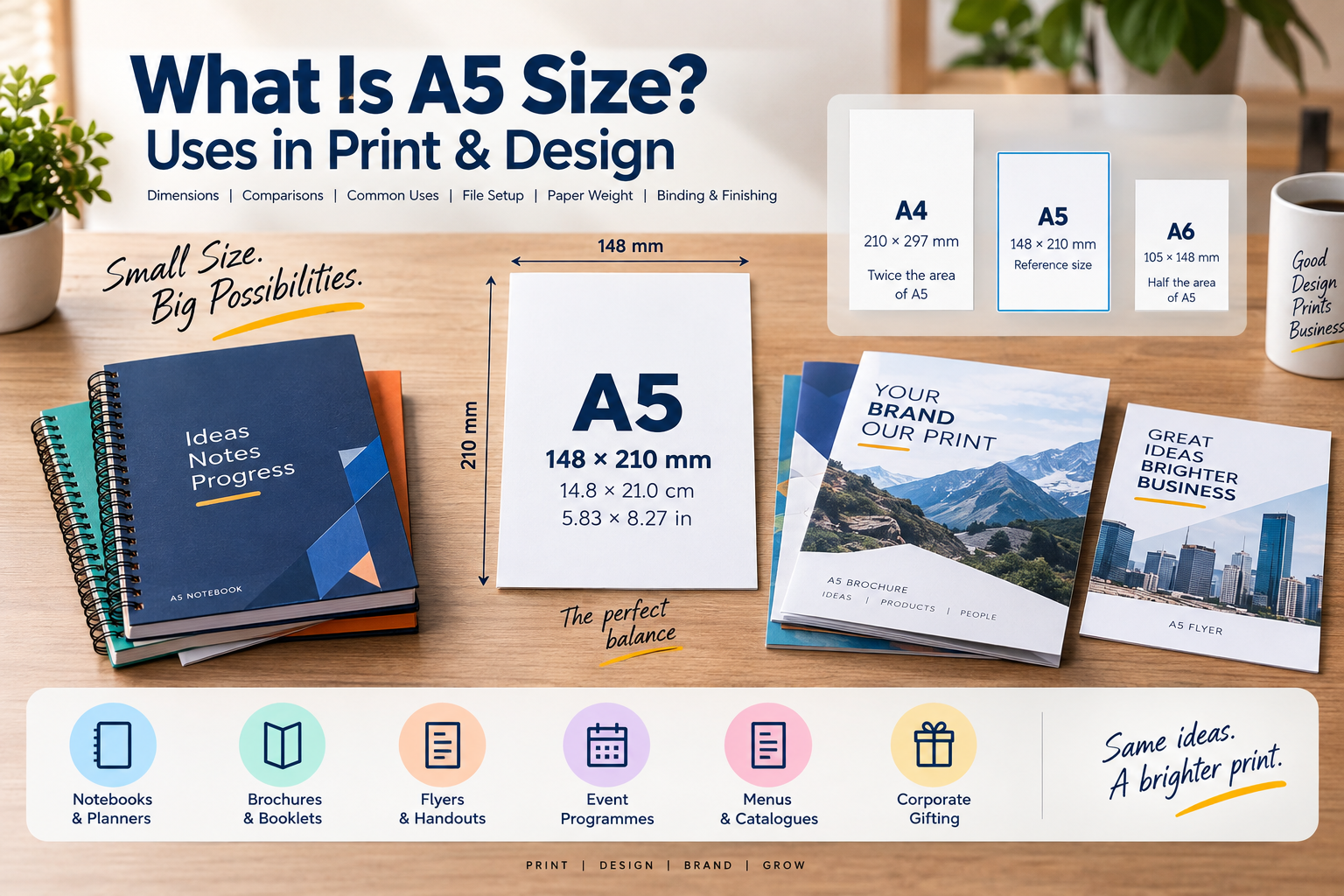
A5 size is defined by the ISO 216 international standard as 148 × 210 mm. In centimetres, that is 14.8 × 21.0 cm. In inches, it converts to approximately 5.83 × 8.27 in, or more precisely 5.827 × 8.268 in. The longer dimension of A5 (210 mm) is identical to the shorter dimension of A4, and that is not a coincidence. It reflects a deliberate mathematical relationship built into the entire ISO A-series, which the next section explains.
Why you'll see slightly different numbers across sources
Different sources round the same ISO measurement in different ways. You may encounter 14.85 × 21 cm, or 5.8 × 8.3 in, or occasionally 15 × 21 cm when someone has rounded aggressively. These are all approximations of the same underlying standard. For design files and print-ready artwork, always use 148 × 210 mm as your trim size. Submitting a file at any other dimension risks unexpected crops during production, and a good print shop will flag this before running your job.
A5 size vs A4 and A6, what to expect
The halving rule and the 1:√2 aspect ratio
Every ISO A-series size shares an aspect ratio of 1:√2. This property means that when you fold a sheet in half along its longer side, the smaller piece has exactly the same proportions as the original. Fold an A4 sheet (210 × 297 mm) in half and you get two A5 sheets (148 × 210 mm). Fold an A5 sheet in half and you get two A6 sheets (105 × 148 mm). A5 is therefore half the area of A4 and twice the area of A6.
SizeDimensionsRelationship to A5A4210 × 297 mmTwice the area of A5A5148 × 210 mmReference sizeA6105 × 148 mmHalf the area of A5 Practical printing implications of this relationship
Two A5 pages print on one A4 sheet, which directly affects how a printer imposes your artwork and how you're charged for stock. An A4 sheet folded once becomes the two outer pages of an A5 booklet, which is the basis of saddle-stitch booklet production. A6 cards can be cut two-up from A5 stock. Understanding these relationships helps you brief a printer more accurately and allows your designer to set up artwork that works within the production workflow rather than against it.
What A5 is actually used for
Notebooks, planners, and journals
A5 size is the dominant format for branded corporate notebooks and personal planners in India. It sits in a practical middle ground: large enough to write on comfortably, compact enough to slip into a laptop bag or conference kit. For businesses across Delhi NCR ordering custom notebooks for employee onboarding, client gifting, or conference goodie bags, A5 is consistently the most requested size. At Bajaj Enterprises, we print A5 size notebooks with spiral, case-bound, and saddle-stitched finishes, with custom covers available in matte and gloss lamination depending on the look the client wants.
Brochures, booklets, and flyers
A5 works particularly well for product catalogues, restaurant menus, course guides, training booklets, and event programmes. It carries enough content to be useful without feeling overwhelming in a reader's hands. A5 flyers are widely used for retail counter displays, trade show handouts, and inserts within packaging because large-volume print runs keep unit costs low. When produced as a saddle-stitched booklet from A4 sheets, the format keeps production costs lower than larger formats while still offering a professional finish. Bajaj Enterprises prints A5 brochures and booklets with precise colour accuracy on the Konica Minolta AccurioPress for clients across South Delhi and NCR, including same-day express options for urgent requirements.
Choosing the right paper weight (GSM) for your A5 job
GSM guide for notebooks, planners, and journals
For everyday A5 size notebooks, 70–80 gsm is the standard inner-page weight. It's affordable, lightweight, and perfectly suited to ballpoint and pencil use. If the notebook is intended for gel pen or fountain pen users, stepping up to 90–100 gsm makes a noticeable difference: less bleed-through, less ghosting on the reverse side. Covers for A5 notebooks should be 250–300 gsm with lamination to give the product structure and durability that holds up through daily use.
GSM guide for flyers, brochures, and booklets
Single-sheet A5 flyers for distribution work best at 130–170 gsm: substantial enough to feel premium in someone's hand without being rigid or difficult to handle in bulk. For A5 booklet interior pages, 80–100 gsm keeps the document comfortable to read without adding unnecessary thickness. Booklet covers should be 250–300 gsm with lamination for structure. For higher-end marketing brochures where the tactile impression matters as much as the content, 170 gsm text stock with soft-touch lamination on the cover creates a noticeably more polished result than standard coated stock.
Setting up your A5 file for print
Bleed, trim, and safe zones: the three measurements you need
For an A5 print file, the trim size is 148 × 210 mm. Add 3 mm bleed on all four sides, making your full artwork canvas 154 × 216 mm. Any background colours, images, or patterns that extend to the edge of the page must reach the bleed boundary so that trimming doesn't leave a thin white strip at the edge. The safe zone for critical content, text, logos, and QR codes, sits 3–5 mm inside the trim edge, giving a safe working area of roughly 138–142 × 200–204 mm depending on your print shop's specification. Always confirm the exact safe margin requirement with your printer before finalising artwork.
Resolution and pixel dimensions for A5 at 300 DPI
Set your document resolution to 300 DPI for print-quality output. At this resolution, an A5 trim of 148 × 210 mm equals approximately 1748 × 2480 pixels. With 3 mm bleed included on all sides, the canvas becomes 154 × 216 mm, or roughly 1819 × 2551 pixels at 300 DPI. Export your final files as PDF/X-1a or PDF/X-4 with embedded colour profiles. These formats preserve CMYK colour data and font information in a way that a digital print shop using ICC-calibrated equipment can reproduce reliably without guesswork.
A5 templates: getting your layout right from the start
If you're setting up artwork for the first time, starting from a correctly sized A5 template saves time and reduces errors. A good template will have the trim size, bleed, and safe zone already marked as guides, so your designer simply places content within the correct boundaries rather than building the document structure from scratch. When you request files from Bajaj Enterprises, we can supply A5 template guides in standard formats to ensure your artwork arrives print-ready.
Binding and finishing options for A5 documents
Binding methods and their practical constraints
Saddle stitching (stapled spine) is the most common and cost-effective option for A5 booklets of 8–72 pages, with page counts in multiples of four. Perfect binding gives a flat, book-like spine and is practical from approximately 44 pages upward, making it well-suited to thicker A5 catalogues, product guides, or training materials.
Wire-O and spiral binding allow the document to lie completely flat when open, making them ideal for workbooks, planners, and training manuals where the user needs both hands free. Comb binding suits editable reports and presentations of 10–100 sheets. For gutter margins, allow a minimum of 10 mm on the binding edge; thermal binding requires at least 18 mm to ensure the adhesive grips properly through the spine.
Cover finishes that change how A5 feels in the hand
Matte lamination gives a calm, understated finish that resists fingerprints and photographs cleanly, making it a popular choice for corporate notebooks and professional reports. Gloss lamination makes colours appear richer and more saturated, which works well for image-heavy covers and marketing brochures.
Soft-touch lamination adds a velvety texture that elevates the perceived quality significantly; it's particularly popular for premium branded notebooks and booklets where the tactile experience is part of the brand message. Spot UV can add selective gloss over logos or titles on an otherwise matte cover, creating a high-contrast, high-end effect without changing the full cover finish.
Summary and next steps
A5 size is 148 × 210 mm: half the area of A4, twice the area of A6, and one of the most versatile formats in commercial print. The key decisions that determine whether your A5 job succeeds are the same every time: match your paper weight to your product type, include a 3 mm bleed in your artwork, and set your file to 300 DPI before you submit it. Getting these three things right before production begins eliminates the most common causes of reprints and delays, as the client from our Kalkaji shop discovered, catching a dimension mismatch before production is far less costly than fixing it after.
Choosing the right A5 size, paper weight, and finish before you place an order saves time, avoids unnecessary costs, and produces a result your audience will actually notice. A well-printed A5 size notebook or brochure communicates something about your brand before a single word is read.
If you're based in Delhi NCR and planning an A5 notebook, brochure, booklet or any other print job, get in touch with the team at Bajaj Enterprises in Kalkaji. We offer free digital proofs before production begins, so you can verify exactly how your A5 artwork will look before a single sheet is printed. For urgent requirements, express printing with doorstep delivery across Delhi NCR is also available.